Greenhouse Gas Emissions From Beef Cattle Pen Surfaces in North Dakota
iii. Methane Emissions
three.1. Full emissions
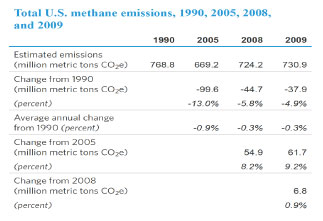
The major sources of U.S. methane emissions are energy production, distribution, and apply; agriculture; and waste management (Figure 17). U.Southward. methane emissions in 2009 totaled 731 MMTCOiieast, 0.9 per centum college than the 2008 total of 724 MMTCO2east (Table 17).
Methane emissions declined steadily from 1990 to 2001, as emissions from coal mining and landfills roughshod, then rose from 2002 to 2009 as a effect of moderate increases in emissions related to free energy, agronomics, and waste management that more than than start a reject in industrial emissions of methyl hydride over the same menses.
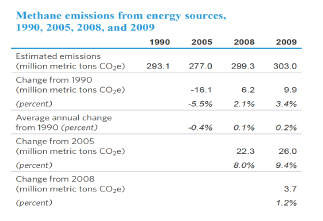
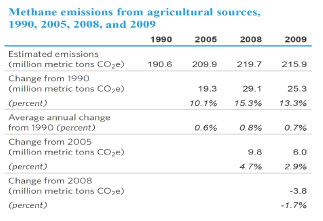
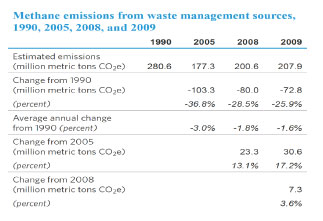
The free energy sector—including coal mining, natural gas systems, petroleum systems, and stationary and mobile combustion—is the largest source of U.S. methane emissions, bookkeeping for 303 MMTCOtwoe in 2009. Agricultural emissions (primarily from livestock direction) and emissions from waste product management (primarily landfills) also are large sources of U.South. methane emissions, contributing 216 and 208 MMTCO2east, respectively, in 2009.
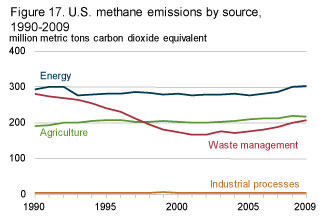
Figure Information
three.ii. Energy sources
Natural gas systems and coal mines are the major sources of methane emissions in the energy sector (Figure 18 and Table 18). U.Southward. methane emissions from natural gas systems grew from 1990 to 2009 past 27 percent (39 MMTCOiieast), largely considering of increases in natural gas consumption. Emissions from coal mines declined from 1990 to 2002 and remained nearly steady through 2007. In 2009, emissions from ventilation and degasification systems at cloak-and-dagger mines increased by nine.two percent, leading to a 4.viii-per centum increment in total cyberspace emissions from coal mining over the 2008 level, despite declines in emissions from both surface mining and post-mining activities.
With domestic oil production dropping past 28 percentage from 1990 to 2009, marsh gas emissions from petroleum exploration and production have declined by the same percentage.
Residential wood consumption accounted for just over 45 per centum of U.Due south. methane emissions from stationary combustion in 2009.
Methane emissions from passenger cars fell past 77 percentage from 1990 to 2009, as the apply of catalytic converters increased. An 11-percent driblet from 2001 to 2009 in annual miles traveled past passenger cars also contributed to the decrease in emissions.
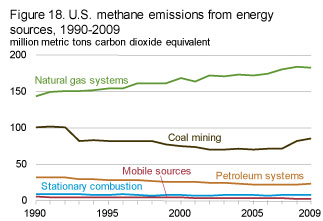
Figure Information
3.3. Agricultural sources
Livestock direction—including emissions from enteric fermentation (67 percent) and direction of animal waste matter (27 percentage)—accounts for the largest share of U.S. marsh gas emissions from agronomical activities (Figure 19 and Table 19). Since 1990, there has been a shift in livestock management to larger facilities that manage waste in liquid systems, increasing the amount of marsh gas generated from livestock waste. Increases in the U.S. swine population since 1990 accept also contributed to the rising in methane emissions. Emissions of methane from animate being waste product fell past i.seven percentage from 2008 to 2009. Swine deemed for 42 percent (25 MMTCOtwoeastward), and dairy cattle accounted for 49 per centum (28 MMTCO2e), of full methane emissions from livestock manure in 2009.
Enteric fermentation (food digestion) in ruminant animals also produces methane emissions, and digestion by cattle accounts for 96 percent of U.S. marsh gas emissions from this source. With trivial change in the cattle population since 1990, the level of emissions from enteric fermentation has been relatively stable, with a small subtract of 3 MMTCO2eastward (two.2 percent) in 2009 from the 2008 level.
Methyl hydride emissions from rice tillage in the United States increased by virtually 4 percent (0.4 MMTCO2eastward) from 2008 to 2009.
Emissions from crop remainder burning increased by 4 percent from 2008 to 2009. Residue burning remains the smallest correspondent to methane emissions from agriculture, representing less than 1 percent of total U.Southward. methane emissions from agriculture.
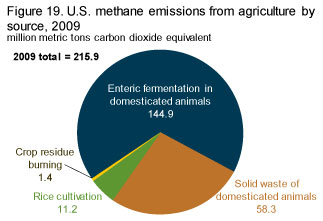
Figure Information
iii.4 Waste matter direction sources
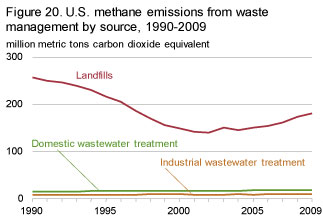
Methane emissions from waste management are dominated by the decomposition of solid waste in municipal and industrial landfills (Figure 20 and Table xx). Emissions from landfills declined substantially from 1990 to 2001 as a result of increases in recycling and in the recovery of landfill methane for free energy; since 2001, increases in the full corporeality of waste deposited in landfills have resulted in almanac increases in methane emissions. The rapid growth in methane recovery from landfills during the 1990s can be traced in part to the Federal Department 29 taxation credit for alternative energy sources, which provided a subsidy of approximately 1 cent per kilowatthour for electricity generated from landfill gas before June 1998. The U.S. EPA's New Source Performance Standards and Emission Guidelines, which crave large landfills to collect and burn landfill gas, accept also played an important role in the growth of marsh gas recovery. In addition, the American Recovery and Reinvestment Human action of 2009 included a 2-year extension (through December 31, 2012) of the production tax credit for renewable energy, including waste product-to-energy and landfill gas combustion.
Wastewater treatment, including both domestic wastewater (about 2-thirds) and industrial wastewater (almost one-tertiary), is responsible for 14 percent (28 MMTCOtwodue east) of marsh gas emissions from waste management. In 2009, emissions from wastewater treatment at pulp and newspaper manufacturing facilities deemed for 47 per centum (5 MMTCOiie) of total emissions from industrial wastewater, and emissions from meat and poultry packing facilities deemed for some other 41 percent (4 MMTCOtwodue east).
Effigy Data
3.5. Industrial process sources
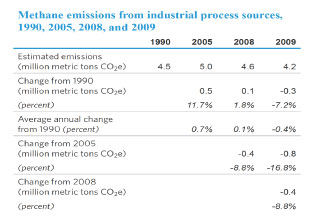
Methyl hydride emissions are generated by industrial processes in the production of iron and steel and chemicals (Figure 21 and Table 21). Full methane emissions from industrial processes declined by a net 0.four MMTCO2e (9 percentage) from 2008 to 2009, as a event of declines in both chemical production and iron and steel production. Similarly, large decreases during 2009 in production of grunter iron, coke, and sinter associated with fe and steel production acquired marsh gas emissions from this industrial source to drop by 43.6 per centum (0.3 MMTCO2e) from the 2008 level.
In 2009, methane emissions from industrial processes dropped below 1990 levels for the first fourth dimension, resulting in a cyberspace decline of 0.3 MMTCO2east (7.2 pct) over the past two decades; however, the 2009 decline is associated with the impact of the recession on industrial production in 2009, and emissions from industrial processes can exist expected to rebound equally the U.S. economy recovers.
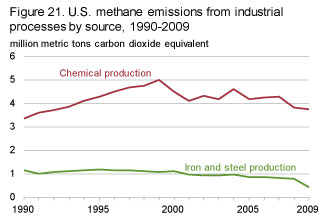
Figure Data
Source: https://www.eia.gov/environment/emissions/ghg_report/ghg_methane.php
0 Response to "Greenhouse Gas Emissions From Beef Cattle Pen Surfaces in North Dakota"
Post a Comment